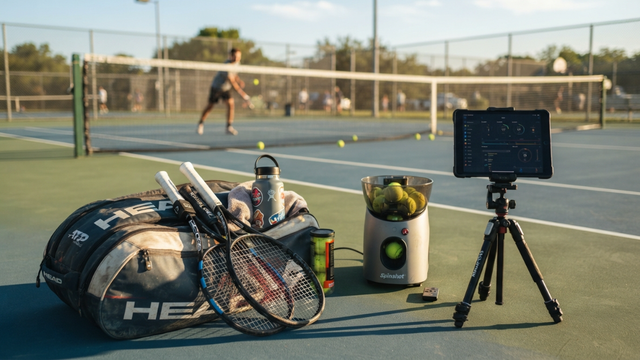
Getting the most out of a training machine often comes down to details that have nothing to do with the core feeding mechanism. An AI Vision Module added to an existing machine, for example, can extend its capability significantly without requiring a full equipment replacement, turning a basic feeder into a system capable of tracking and adaptive drilling.
Battery management is one of the more practical concerns for anyone running longer sessions or group clinics. A machine that shuts down mid-session due to a depleted battery interrupts training flow in a way that's genuinely frustrating, particularly during structured group drills where multiple players are waiting for their turn. A swappable battery setup avoids this by allowing a quick swap rather than a full charging pause, which can otherwise turn a planned hour of practice into a much shorter, less productive session.
Hands-free control accessories, like a voice-command armband, solve a related but distinct problem: minimizing interruptions during active drilling. Every manual adjustment mid-session — walking to a control panel, pausing to change a setting — breaks the continuity that makes practice feel closer to actual match conditions. Voice control keeps that flow intact, which matters more during high-intensity, footwork-focused drills than it might during simple, slow-paced warm-up feeding.
For players building out a more complete training setup over time, it's worth checking the main product range at Tenniix alongside available accessories, since some machines are specifically designed to support these upgrades while others have more limited compatibility.
Thinking about accessories early, rather than as an afterthought, tends to produce a more usable long-term setup. A machine that's difficult to keep running for a full session, due to battery limitations or clunky manual controls, ends up getting used less than one built with these practical details considered from the start.
Group and clinic settings benefit especially from a well-accessorized setup, since multiple players sharing a single machine over an extended session put more demand on battery life and control convenience than a single player training alone typically would. Coaches running clinics regularly cite these small details as the difference between a smooth session and one interrupted by equipment downtime.
Budgeting for accessories at the time of the original purchase, rather than as a series of later add-ons, often works out more efficiently overall. Bundled pricing is sometimes available, and knowing upfront which accessories are likely to matter for a given training routine can simplify the buying decision considerably compared to piecing together add-ons reactively over time.
It's also worth asking current owners, through local club forums or community groups, which accessories they actually use regularly versus which ones ended up rarely touched after the first few sessions. Real-world usage patterns from other players are often more informative than a product page alone when deciding which upgrades are genuinely worth the added cost for a specific training routine.
FAQ
Does adding an AI Vision Module require technical expertise? Most modules are designed for straightforward installation, though checking specific compatibility with an existing machine is recommended first.
How much does a swappable battery typically extend session length? This varies by model and usage, but swappable batteries are generally designed to support significantly longer uninterrupted sessions.
Are voice-control accessories compatible with all machines? Compatibility varies by product line, so checking specifications before purchase is worthwhile.
Do accessories matter more for group clinics than individual practice? Yes, extended use across multiple players tends to make battery life and hands-free control more noticeably valuable than in typical solo sessions.
Comments