AED 10,000 Mistake: Missing Corporate Tax Registration in the UAEA Costly Oversight That Started Like Any Other Business Day
Ahmed never imagined that a routine email from the tax authority would change how he viewed compliance forever.
He had built his company steadily over four years. Revenue was growing. Clients were happy. His accountant handled VAT filings on time. In Ahmed’s mind, taxes were under control. Then came the message that stopped him cold.
A penalty notice. AED 10,000. The reason was simple and devastating. He had missed Corporate Tax Registration.
No fraud. No evasion. No late payment of tax. Just a missed registration deadline.
This is not Ahmed’s story alone. It is becoming one of the most common and expensive mistakes businesses across the UAE are making since the introduction of UAE Corporate Tax. The rules are new, the timelines are strict, and the penalties are real.
This article explains exactly what happens when Corporate Tax Registration is missed, why so many businesses fall into this trap, and what every company must do to protect itself.
Why Corporate Tax Changed the Compliance Landscape in the UAE
For decades, businesses in the UAE operated under a tax-light environment. VAT was the major compliance requirement, and even that was limited in scope for many sectors. Corporate income tax existed only in specific industries.
That era has ended.
With the introduction of the UAE Corporate Tax, compliance expectations shifted overnight. Every taxable person, regardless of profit level, must now understand their obligations around Corporate Tax Registration.
This includes:
- Mainland companies
- Free zone entities
- Startups and SMEs
- Professional service providers
- Foreign companies with UAE presence
- Individuals conducting licensed business activities
Many business owners mistakenly assumed that tax liability and registration were the same thing. They are not.
You may owe zero tax and still be legally required to complete Corporate Tax Registration.
What Exactly Is Corporate Tax Registration?
Corporate Tax Registration is the formal process of enrolling your business with the UAE tax authority under the corporate tax regime.
It is not optional. It is not triggered by profit. It is not dependent on VAT registration status.
Registration establishes your company as a recognized taxable person. Only after this step can you:
- File corporate tax returns
- Claim exemptions or reliefs
- Maintain compliance status
- Avoid administrative penalties
Failing to complete Corporate Tax Registration on time is treated as a compliance breach, even if your tax payable is zero.
The AED 10,000 Penalty Explained Clearly
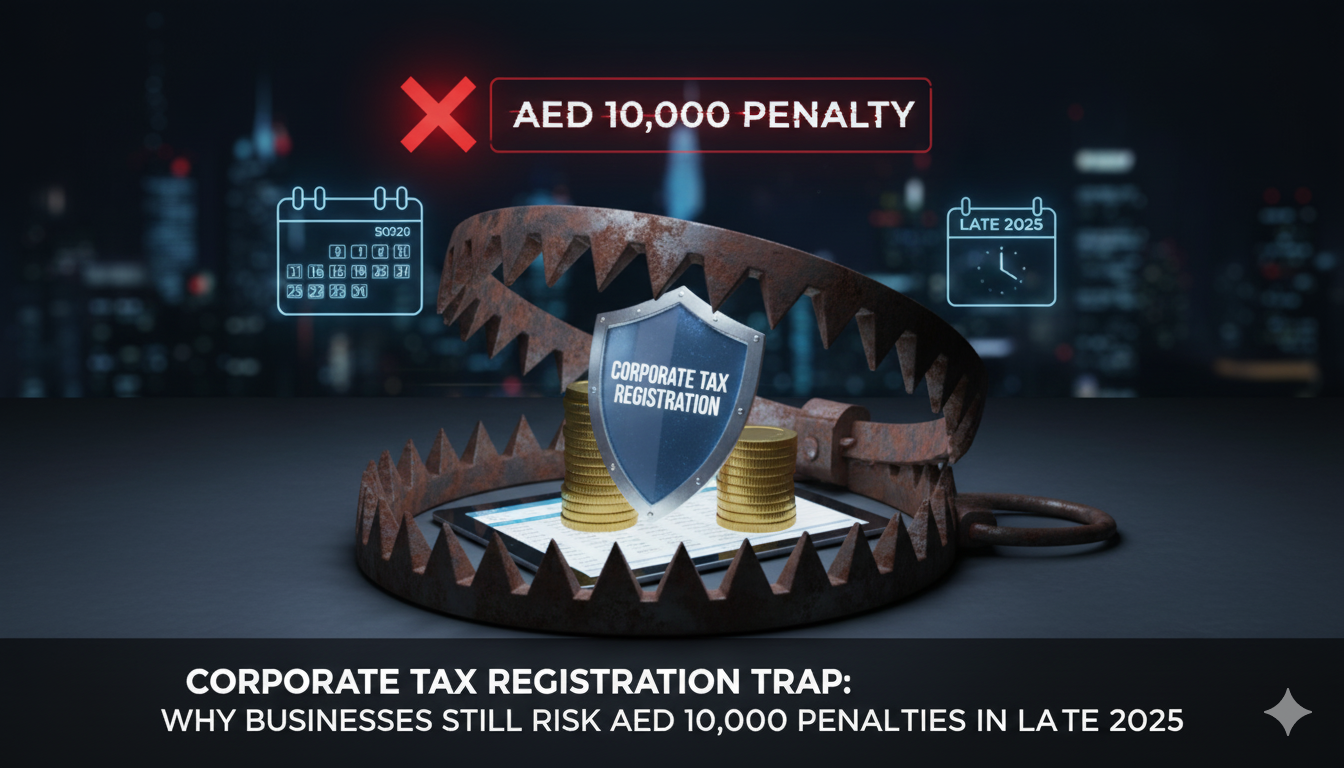
Let us be blunt. The AED 10,000 penalty is not a warning. It is not symbolic. It is immediately enforceable.
When a business misses the Corporate Tax Registration deadline, the tax authority imposes an administrative fine of AED 10,000.
This penalty applies:
- Per entity
- Regardless of turnover
- Regardless of profit or loss
- Regardless of intent
Ahmed learned this the hard way. His business qualified for zero percent tax due to revenue thresholds, but the penalty still applied because Corporate Tax Registration was not completed within the prescribed timeframe.
The system does not care why you missed it. It only checks whether you did.
Who Is Most at Risk of Missing Corporate Tax Registration?
Based on real market behavior, several categories of businesses are especially vulnerable.
Small and Medium Enterprises
SMEs often operate lean. Owners handle sales, operations, and finance themselves. Tax compliance becomes reactive rather than proactive. Many assume their accountant will notify them, while accountants assume the owner is informed.
This gap is where Corporate Tax Registration deadlines are missed.
Free Zone Companies
A widespread misconception is that free zone companies are exempt from all corporate tax obligations. While some qualify for special treatment, registration is still mandatory.
Failing Corporate Tax Registration puts even qualifying free zone entities at risk of penalties.
New Businesses
Startups often focus on incorporation, banking, visas, and revenue. Tax registration feels distant. Unfortunately, Corporate Tax Registration timelines start earlier than many expect.
Individuals With Business Licenses
Freelancers, consultants, and professionals operating under licenses are frequently unaware that they are considered taxable persons. If income crosses thresholds or activities qualify, Corporate Tax Registration becomes mandatory.
The Psychological Trap That Leads to Non-Compliance
One of the biggest reasons businesses miss Corporate Tax Registration is psychological, not technical.
Business owners assume silence means safety.
No reminder email. No phone call. No warning letter.
But the UAE tax system is digital, automated, and deadline-driven. It does not chase. It penalizes.
Ahmed admitted later that he saw posts on social media discussing corporate tax but assumed they applied to larger companies. That assumption cost him AED 10,000.
How the Registration Deadline Is Determined
The Corporate Tax Registration deadline is not random. It depends on factors such as:
- Date of trade license issuance
- Legal form of the entity
- Whether the entity existed before the corporate tax introduction
- Whether the entity is newly incorporated
Many businesses fail because they rely on generic timelines instead of their specific registration window.
Missing the correct window, even by one day, triggers penalties.
What Happens After You Miss the Deadline?
Missing Corporate Tax Registration sets off a chain reaction.
First comes the penalty. Then come compliance complications.
Immediate Financial Impact
The AED 10,000 penalty must be paid. It does not offset future tax. It does not reduce liability. It is a pure loss.
Increased Scrutiny
Once flagged, the business often experiences closer monitoring. Future filings are reviewed more carefully.
Compounded Risk
Late registration often leads to late return filing, which can trigger additional penalties.
Stress and Operational Disruption
Business owners lose time dealing with rectification, appeals, and compliance clean-up instead of focusing on growth.
Ahmed described the experience as frustrating and avoidable. The penalty was not what hurt most. It was realized that a simple administrative step had been overlooked.
The Silent Role of Social Media in Spreading Confusion
Social media has become a double-edged sword in the corporate tax conversation.
While some content educates, much of it oversimplifies. Phrases like “only profitable companies need to worry” or “free zones are exempt” circulate widely without context.
This misinformation contributes directly to missed Corporate Tax Registration.
The reality is more nuanced. Exemptions do not eliminate registration. Zero percent tax does not remove filing obligations. Silence from authorities does not imply exemption.
Corporate Tax Registration Is a Legal Identity, Not a Tax Bill
This distinction is critical.
Corporate Tax Registration is about identity and recognition within the tax system. Tax payment is a separate outcome that comes later.
Think of registration as opening a file. Whether that file shows tax due depends on your numbers. But if the file does not exist, the system treats it as non-compliant.
Businesses that understand this difference do not miss deadlines.
Why Waiting for Your Accountant Is a Risky Strategy
Many penalties occur because of assumed responsibility.
Owners assume accountants will handle Corporate Tax Registration. Accountants assume owners will authorize or initiate the process.
Without explicit confirmation, nothing happens.
The most successful businesses treat Corporate Tax Registration as a board-level responsibility, not an afterthought delegated without oversight.
Correcting the Mistake After the Penalty
Once the penalty is issued, options become limited.
Registration must still be completed. Appeals may be possible in specific circumstances, but success is not guaranteed.
The key lesson is prevention.
No strategy, no appeal, no justification is cheaper than registering on time.

How Businesses Can Protect Themselves Going Forward
Avoiding penalties is not about complexity. It is about discipline.
Build a Compliance Calendar
Track all tax-related obligations, including Corporate Tax Registration, return filing, and payment deadlines.
Assign Clear Responsibility
One person must own compliance. Not a department. Not a vague role. A name.
Validate Assumptions
Never assume an exemption without confirmation. UAE Corporate Tax rules are precise and assumption-punishing.
Act Early
Early Corporate Tax Registration carries no downside. Late registration carries guaranteed risk.
The Long Term Cost of Ignoring Corporate Tax Obligations
The AED 10,000 penalty is only the beginning.
Businesses that treat Corporate Tax Registration casually often struggle later with:
- Incorrect filings
- Missed relief opportunities
- Audit exposure
- Reputational damage
- Licensing complications
Compliance builds credibility. Non-compliance erodes it quietly and consistently.
A Final Reflection From Ahmed
Months after paying the penalty, Ahmed changed how he ran his company.
Compliance became proactive. Advisors were consulted earlier. Assumptions were challenged.
He often tells fellow entrepreneurs that Corporate Tax Registration was the cheapest lesson he never wanted to learn.
AED 10,000 bought clarity, but it did not have to.
Conclusion: Corporate Tax Registration Is Not Optional, It Is Foundational
The introduction of UAE Corporate Tax marked a defining shift for businesses operating in the country. It introduced clarity, structure, and long-term sustainability, but it also brought enforceable rules that leave little room for assumptions or delays. This system is built on precision, and businesses that fail to adapt quickly are learning costly lessons.
At the heart of this framework lies Corporate Tax Registration. It is not a formality. It is not a technical step that can be postponed. It is the legal gateway into the corporate tax system, and missing it is not treated as a minor oversight. It is recognized as a compliance failure with immediate financial consequences.
What makes this mistake particularly painful is its simplicity. Businesses are not penalized for wrongdoing or aggressive tax behavior. They are penalized for inaction. A missed deadline. A misunderstood rule. An assumption that someone else was handling it. These are the small gaps where penalties quietly enter.
The most important takeaway is clear. Businesses do not need to fear corporate tax itself. What they must respect are deadlines, registration requirements, and proactive compliance. When these are handled correctly, corporate tax becomes manageable, predictable, and even strategic.
This is why guidance matters. At Dubai Business and Tax Advisors, our focus has always been on helping businesses transition from confusion to clarity, from reactive compliance to informed decision-making. Corporate tax is no longer a concern for the future. It is a present obligation, and the businesses that succeed are the ones that address it early and correctly.
Because in the UAE’s evolving tax landscape, the most expensive mistake is rarely the tax you pay.
It is the Corporate Tax Registration that you failed to complete on time. It is failing to register at all.
Comments